


This past weekend I watched a documentary on Hulu that has captured my thoughts for the better part of the last few days. Of course, this is a tell-tale sign that another golden life musing is on the horizon.
“Brats” documents the love/hate (mostly hate) relationship that the young movie stars of the 80’s “Brat Pack” had with the name assigned to them without their permission, but took on a life of its own, nonetheless.
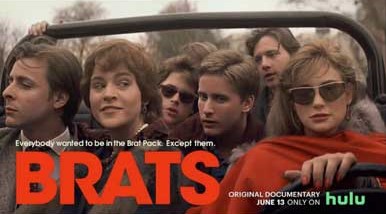
What I found fascinating about this film was how it gave a front-row seat to how one shared experience could have very different impacts on each of those who lived through it. And in their own words, it is clear how their lives lived since that experience was largely based on how they perceived it.
Andrew McCarthy, the man behind the film, seems to paint a picture in the first thirty minutes that the coining of the name for this group the Brat Pack essentially ruined the careers (and social lives) of those who fell into this category. After all, the witty phrase, a play on the popular ’60s group called the “Rat Pack,” came from David Blum’s 1985 article in New York Magazine that featured these new stars in a not-so-complimentary way. As I watched, it became clear that the author who started it all was trying to be more clever and salacious than hateful and disruptive in coining this term, but the collateral damage it caused was evident.
Like most of the children of the 80s, my experience with these films was a positive one. I heard later that the stars in these films were, in my eyes, affectionately called the Brat Pack, but I never knew why. Movies like “Sixteen Candles”, “Weird Science”, and “Pretty in Pink” were some of my favorites. But being in the single digits at that time, I was completely lost on the term’s negative connotation.
In the article, David Blum questioned the seriousness of this new generation of actors who gained a huge amount of notoriety and success in a short period during the ‘80s. Candidly, in his interview for the film, he was in a way poking fun at them, but not in a devious way. However, the result was this group of actors stopped socializing with each other off-screen, and some of them believed because of the popularity of the article, they were perceived as “brats” and essentially in their eyes, blacklisted in Hollywood.
The interesting thing, however, is that several of the actors associated with this so-called Brat Pack – Demi Moore, Rob Lowe, Emilio Estevez – went on to have varying degrees of success in Hollywood. Even some actors considered “Brat Pack-adjacent” and sometimes included in the group – Robert Downey, Jr., Nicholas Cage, Matthew Broderick, and Kevin Bacon – have had long, successful careers, despite their share of controversy and drama.
So what made the difference for why some of these actors’ careers soared, while the others’ tanked?
I believe it had very little to do with their talents and everything to do with their perception. Of those interviewed, including Andrew McCarthy himself, the actors who believed that the article held negative power over their careers were those whose names you probably don’t remember. Conversely, those who didn’t put much weight on the article and its impact had varying degrees of success in the industry.
From Demi Moore’s perspective in the film, the article wasn’t as much about these actors as the author trying to be witty and make a name for himself. She didn’t believe it was flattering, but she also did not assign any value to it as it related to her career. It was no surprise to me considering her mindset, she was arguably the most successful actor of the Brat Packers. In contrast, another set of the Brat Pack actors believed that the article meant the end of their short careers, and for them, it was.

We each have our own perception of what transpires in our lives, and as a result, we add meaning or purpose to it. Sometimes that meaning we attach to what happens to us can have huge implications. In this case, life or death of a career. To me, this means that we have much more power than we give ourselves credit. Our perception shapes our reality.

So what if we consciously decided to perceive whatever happens to us, seemingly good or bad, through the lens of our power and not our limitations?
In a way, the film touched on how the fear of the backlash and impact of the article essentially paralyzed those Brat Pack actors whose careers stalled following its release. Six years ago I wrote a blog post entitled “Be Afraid, Be Very Afraid,” where I shared some insights on using fear as a motivator for our pursuits instead of allowing it to be a blocker. I believe if we applied these principles to every area of our lives where we experience fear, we’d have way more of the success we desire. I don’t want to oversimplify life here and imply that undesired things won’t happen to us all at some point. But I do think that how we perceive those undesired experiences matters, and our lives will prove it.
For more golden life ventures visit www.goldenlifeventures.com.
 Golden Life Musings